Baba Shakespeare is a new production to be staged by Tower Theatre Company at the Arcola Tent from Tuesday 17th April - Wednesday 2nd May 2012 as part of the RSC Open Stages, which has been described as the UK's biggest amateur theatre project.

The script for Baba Shakespeare has been written by director Emmeline Winterbotham and is derived from the screenplay of the 1965 Merchant Ivory film Shakespeare Wallah, a true story that follows the family of actress Felicity Kendal as they travel around post-colonial India as a troupe of Shakespeare players.


Monday, 20 February 2012

Carving the feet

Although the majority of the puppets are carved from jelutong, I am using lime for the hands and feet, as it is denser wood so should take the extra wear and tear from contact with the stage when walking or crawling.  Having cut out the hands and feet this weekend on a bandsaw, this morning I have been working on the feet.  Whilst carving, they are kept joined together so that it is easier to clamp them.

The cut out feet before starting to carve
Sloping the toes down from the high points of the knuckles
Defining the separate toes and knuckles
 I have also sloped the wood up towards the toes on the sole of the feet, which helps the puppet to walk without catching its feet on the floor.

Monday, 6 February 2012

The importance of not losing your head!


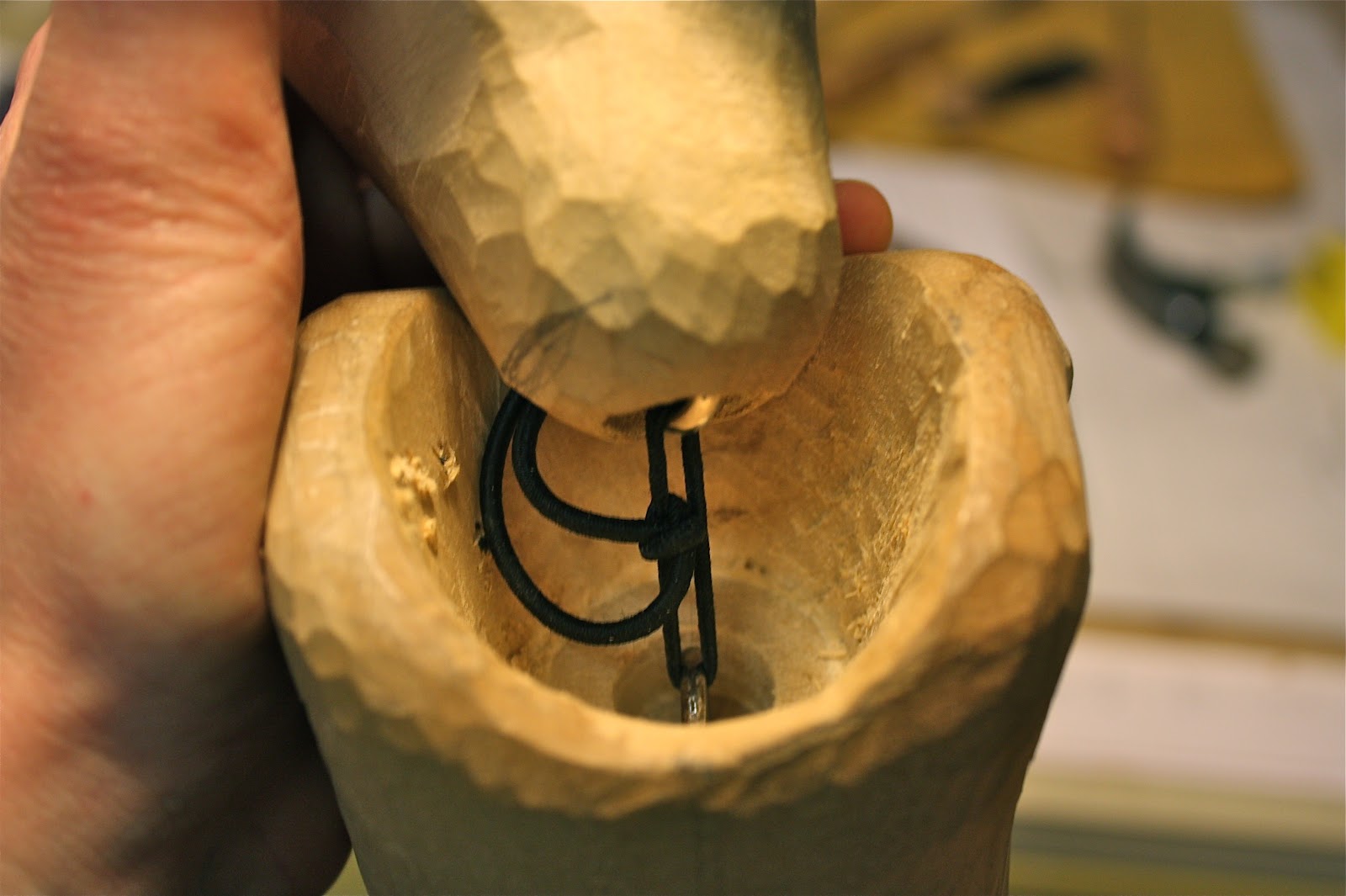
Here is the monkey a week later, with the right contours starting to emerge, the elbow and knee joints operational and the neck sitting nicely inside its socket within the torso and moving in the way I envisaged.  That makes it sound easy!  It is very much a cycle of trial and error, always balancing the form of the monkey against the functional requirements of each joint.  Anyway, you can see from the photo below the socket in the top of the torso that the rounded neck sits in.  The socket is pretty deep and the neck is correspondingly long.  Why?  Well it's so that when the monkey cranes its neck backwards or forwards you don't see a gaping big hole between the body and the head.  There is a largish screw eye embedded into the neck and the bottom of the socket.  They are embedded so that they don't protrude into the joint and stop the neck sitting at the bottom of the socket.  I experimented with fastening a loop of wire between the two screw eyes, but the problem was that its rigidity didn't allow the neck to move enough within the socket to achieve the range of movement required.  I found that strong elastic cord worked better, pulled tight and tied in a double knot.  This is fine during the development of the puppet,  but when it is finally assembled I think the elastic will need to be sewn or glued or both so that the head doesn't fall off during the show!  A big no no!  Apparently though some Chinese marionettes don't actually have the heads fixed to the bodies, and they just rely on gravity to keep them sitting in their sockets.  Hmm.  Tempting, but these monkeys will be rather athletic and may even do handstands, so yes, we will need elastic.


Sunday, 29 January 2012

Taking shape

Gradually the monkey is emerging and taking shape.  It's great to get into the carving, accompanied by Rachmaninov's 3rd piano concerto, which helps me get into the flow.  Here is progress so far on the head.  The ears are going to be made separately and glued on at the end.  The eyes will be hollow sockets.  At the moment the head is still slightly square, so needs to be rounded off further.  I'm also contemplating how to tackle the tufty sideburns that rhesus macaques monkeys often have.


Here is the left leg, also needing more rounding, but I will do this once the knee joint has taken shape.  I'm working simultaneously on the torso, legs and head, so that I can fine tune how the joints fit together.   Since monkeys rarely stand fully upright, I am designing the knees so that the legs do not straighten up completely.


Thursday, 19 January 2012

Inside the Arcola Tent

Today Emma and I paid a visit to the Arcola Tent, which is where Baba Shakespeare will be performed in the spring.  Emma and I will be operating the monkey marionettes, and we wanted to get a feel for the space and what we can achieve within it.  It was exciting to get in there and see what it is like.  We took Junkie Monkey so that we could experiment with a puppet and try out some initial ideas for the performance.


Monday, 16 January 2012

Chop Chop!

It is time for me to cut out my designs on a bandsaw.  First the front and side elevations are transferred onto the wood, which has been squared up using a plane.  Below you can see the right lower leg under the pillar drill.  The holes for the joints are drilled whilst the wood is still square, which makes it much easier to get them nice and straight.


Below is the female monkey in a very primitive state, with all the wood still around the drawings.  Before bandsaws were around, this excess wood had to be removed by hand with a large chisel, but now this can be done faster and more accurately with a machine.  The wood here is jelutong; the hands and feet will be made later on out of lime.


Here is some bandsawing going on.  The trick is to cut out the first side of the design but not all the way round; if you leave tiny sections still attached, then the wood doesn't come off, which means you can turn the block over to cut out the second side and the base of the wood is still flat.  At the end you can go back and remove the wood around the first elevation using the bandsaw or a coping saw.


Here is the monkey post bandsaw, still looking a little strange but that will soon change once I start carving and the hard edges get taken off.

Thursday, 12 January 2012

Junkie monkey finding her feet

Late last night I finished junkie monkey.  Here is a 3 minute video of her trying out some moves on the kitchen table.  It's lovely when you first finish a puppet, however rough, and get to bring it to life for the first time.


I'm pleased with the range of movements I can get with this marionette: standing, crawling and sitting.  Ideally the knee joints would be a bit looser, but it's definitely helpful to have a rough puppet to play with while we try out ideas for the show.  The control is an upright one normally used for human marionettes (animals tend to have horizontal controls).  Although the monkeys will probably need to crawl as well as sit and stand, because they are performing monkeys I think they will spend more time upright, so it is likely that the controls will a slightly modified version of the upright control.